

The $5 Trillion Question: Understanding the Municipal Bond Thesis-- Property Taxes, Municipal Bonds, and the Investigation Led by Mitch Vexler.
Behind the Property Tax Curtain: Mitch Vexler’s Investigation Into America’s Municipal Bond System

Mitch Vexler Explains the $5 Trillion Municipal Bond Question
In the interview, real-estate developer and investigator Mitch Vexler explains how he believes inflated property valuations may be tied to trillions in school district bond debt. The conversation walks through the mechanics of appraisal districts, property tax bases, and municipal bond financing.
Mitch Vexler is a Texas real estate developer, investor, and activist who has become known for alleging large-scale fraud in the U.S. property-tax and municipal bond systems.
Background
A builder/developer and investor with decades of experience in real estate.
Based in Flower Mound, Texas, associated with Mockingbird Properties, and development entities such as MAVEX Shops of Flower Mound LLC.
Has spent years analyzing property-tax appraisal data, particularly focusing on Texas Central Appraisal Districts (CADs).
What he is known for
Vexler argues that:
Property appraisal districts systematically inflate property values.
The inflated values are used to justify school-district bond issuances and higher property taxes.
This creates what he claims is a massive financial bubble or fraud, potentially reaching trillions of dollars in municipal debt.
He has claimed the issue could involve roughly $5.1 trillion in questionable bond exposure, possibly much more depending on assumptions.
Activities
Filed legal complaints and amicus briefs related to appraisal-district practices.
Produced videos, spreadsheets, and analyses explaining his theory of systemic property-tax inflation.
Advocates federal investigations (e.g., by the SEC) into municipal bonds and appraisal practices.
Important context
His claims have circulated widely in alternative finance and activist circles.
However, major financial regulators and mainstream economists have not confirmed a nationwide fraud of the scale he alleges. His work is generally viewed as activist analysis rather than an established consensus finding.
Property Tax Valuations, Municipal Bonds, and the Investigative Work of Mitch Vexler
Why Paralegals Should Be Paying Attention
Across the United States, property taxes fund essential public services…schools, infrastructure, police, and fire protection. Yet in recent years, property owners have become increasingly concerned about rapid increases in assessed values and the downstream financial implications tied to those assessments.
One of the most vocal investigators examining this issue is Texas real-estate developer and analyst Mitch Vexler, who has been compiling extensive data and legal arguments regarding property appraisal systems and their relationship to municipal bond financing.
While his work is ongoing, the legal questions raised by Vexler’s research are significant enough that paralegals working in real estate law, municipal law, tax appeals, and public-finance litigation should be watching closely.
The Core Issue Being Investigated
Vexler’s research centers on a key claim:
Local appraisal districts may be systematically inflating property valuations, which in turn supports the issuance of larger municipal bonds- particularly school district bonds.
His analysis suggests the following potential chain:
Appraisal districts increase assessed property values.
Higher valuations expand the taxable base.
Local governments use the larger tax base to justify issuing larger bonds.
Bond debt obligations increase while taxpayers carry the long-term repayment burden.
Municipal bonds are a cornerstone of public finance in the United States. However, if valuation systems are distorted, the legal integrity of the underlying financial structure could be questioned.
For legal professionals, that raises serious questions about:
compliance with state appraisal statutes
disclosure obligations in bond offerings
taxpayer due-process rights in valuation appeals
potential securities law implications
The Legal Efforts Currently Underway
Mitch Vexler has spent years assembling large datasets comparing:
property appraisal district valuations
actual market transactions
bond issuance volumes
school district tax bases
His work has reportedly involved:
compiling multi-county appraisal data
filing complaints and legal challenges related to appraisal practices
preparing legal briefs addressing taxpayer rights
advocating for federal and regulatory review of municipal bond disclosures
Supporters of the investigation argue that greater transparency in appraisal methodology is essential for protecting both property owners and municipal bond investors.
Why This Matters for Property Owners
Across many states, property owners have experienced assessment increases that far outpace income growth.
For homeowners on fixed incomes, such as retirees or SSDI recipients, rising assessments can translate into significant financial strain.
Legal advocates supporting greater scrutiny of appraisal practices argue that property owners deserve:
transparent valuation formulas
fair appeal procedures
independent oversight of appraisal districts
accurate disclosures tied to bond financing
Even if investigations ultimately reveal only procedural deficiencies rather than systemic misconduct, the conversation itself has already highlighted the need for deeper oversight in property-tax administration.
Potential Legal Implications
If the issues raised by Vexler and others were validated through litigation or regulatory investigation, several legal areas could be affected:
1. Property Tax Appeals
More taxpayers may challenge assessments using market-data comparisons.
2. Municipal Bond Disclosure
Bond prospectuses may face increased scrutiny regarding the assumptions behind tax-base projections.
3. Appraisal District Oversight
State legislatures may consider reforms to appraisal district governance and transparency.
4. Securities Regulation
Federal regulators such as the SEC could potentially review disclosure practices in municipal bond markets.
What Paralegals Should Be Watching
Paralegals working in real estate, tax law, or municipal litigation should monitor developments in several areas:
emerging litigation challenging appraisal districts
legislative proposals addressing property-tax transparency
regulatory actions involving municipal bond disclosures
large-scale taxpayer class actions or coordinated appeals
As this issue evolves, legal teams may increasingly rely on paralegals to gather property data, analyze appraisal records, and support valuation disputes.
Paralegal Practice Checklist
Investigating Property Tax Assessment Issues
Case Intake
☐ Obtain property tax assessment records for the past 5–10 years
☐ Collect property purchase price and appraisal documentation
☐ Gather comparable property sales data
Public Records Review
☐ Retrieve appraisal district methodology documents
☐ Review public bond issuance records for the municipality
☐ Identify valuation trends within the same neighborhood
Data Analysis
☐ Compare assessed value vs. recent market transactions
☐ Identify statistical outliers within appraisal datasets
☐ Review bond prospectuses referencing property tax bases
Legal Documentation
☐ Prepare property-tax protest filings
☐ Assemble evidentiary packets for assessment hearings
☐ Draft summaries comparing appraisal values to actual market prices
Litigation Preparation
☐ Organize expert appraisal reports
☐ Track statutory deadlines for appeals
☐ Maintain a timeline of valuation changes and tax increases
Final Thoughts
The work being undertaken by Mitch Vexler has sparked an important discussion about the intersection of property taxation, municipal finance, and taxpayer rights.
Whether the ultimate outcome leads to litigation, legislative reform, or regulatory scrutiny, one thing is clear: property valuation systems sit at the heart of local government finance, and transparency in those systems benefits everyone—from homeowners to investors to municipalities themselves.
For paralegals, this is precisely the type of evolving legal issue where data analysis, public-records research, and careful documentation can play a decisive role.
As developments continue, legal professionals would be wise to follow this issue closely.
A Step-by-Step Paralegal Guide to Property Tax Appeals
Why Property Tax Appeals Matter
Property tax appeals are one of the most common administrative legal actions affecting homeowners and businesses. When property owners believe their assessed value exceeds market value, they may challenge the assessment through administrative review or litigation.
Paralegals frequently perform the core investigative and documentation work required to support these appeals.
Step 1 – Initial Client Intake
☐ Obtain most recent property tax notice
☐ Identify current assessed value
☐ Confirm property classification (residential, commercial, agricultural)
☐ Gather prior year assessments
Step 2 – Document Collection
☐ Property purchase agreement
☐ HUD-1 or closing disclosure
☐ Independent appraisal reports
☐ property inspection reports
☐ repair estimates (if applicable)
Step 3 – Comparable Property Research
Paralegals should identify comparable sales (often called “comps”).
Key factors include:
• square footage
• lot size
• property age
• location within the same neighborhood
• recent sale dates
Recommended sources:
• county recorder records
• MLS databases
• real estate transaction databases
Step 4 – Assessment Comparison
Create a chart comparing:
PropertyAssessed ValueMarket Sale PriceDifference
Significant disparities may support an appeal.
Step 5 – Preparing the Appeal Filing
Typical documents include:
☐ notice of protest
☐ comparable property analysis
☐ appraisal reports
☐ photographs of property condition
☐ expert valuation opinions (if available)
Step 6 – Hearing Preparation
Paralegals assist attorneys by:
☐ preparing hearing binders
☐ organizing exhibits
☐ summarizing comparable sales
☐ drafting hearing outlines
Data-Analysis Template for Detecting Inflated Property Appraisals
Why Data Analysis Matters
Modern property-tax investigations increasingly rely on large datasets rather than isolated property comparisons.
The work being conducted by analysts such as
Mitch Vexler demonstrates how systematic analysis can reveal patterns across thousands of properties.
Paralegals with strong research skills can become extremely valuable by helping legal teams analyze these datasets.
Paralegal Property Valuation Analysis Template
Spreadsheet Columns
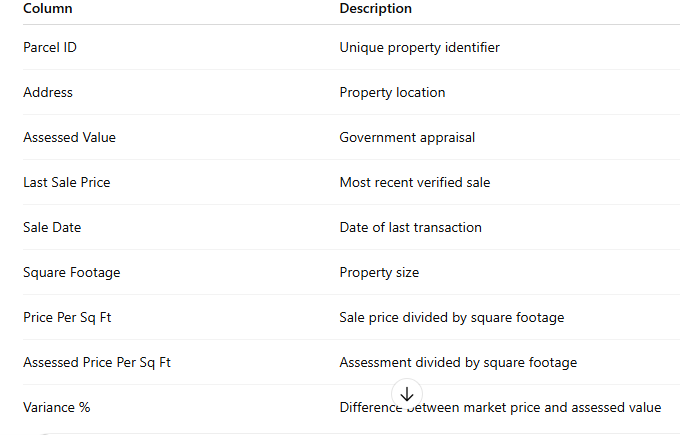
Variance Analysis
Paralegals should flag properties where:
• assessment exceeds sale price by 20–30% or more
• assessments rise rapidly without corresponding market sales
• nearby comparable properties show significantly lower values
Pattern Detection
Large datasets may reveal:
• neighborhood-wide valuation spikes
• assessment trends inconsistent with market sales
• tax-base increases preceding municipal bond issuances
Recommended Data Sources
• county appraisal district databases
• county recorder offices
• property tax assessor records
• municipal bond disclosures
• real estate transaction datasets
Final Thoughts
The intersection of property taxation, municipal finance, and data analysis is becoming an increasingly important area of legal practice.
Investigations and research conducted by individuals such as
Mitch Vexler highlight how complex financial systems can intersect with everyday property ownership.
For paralegals, developing skills in:
• public records research
• property-tax law
• valuation analysis
• municipal finance documentation
may become increasingly valuable as these issues continue to evolve.